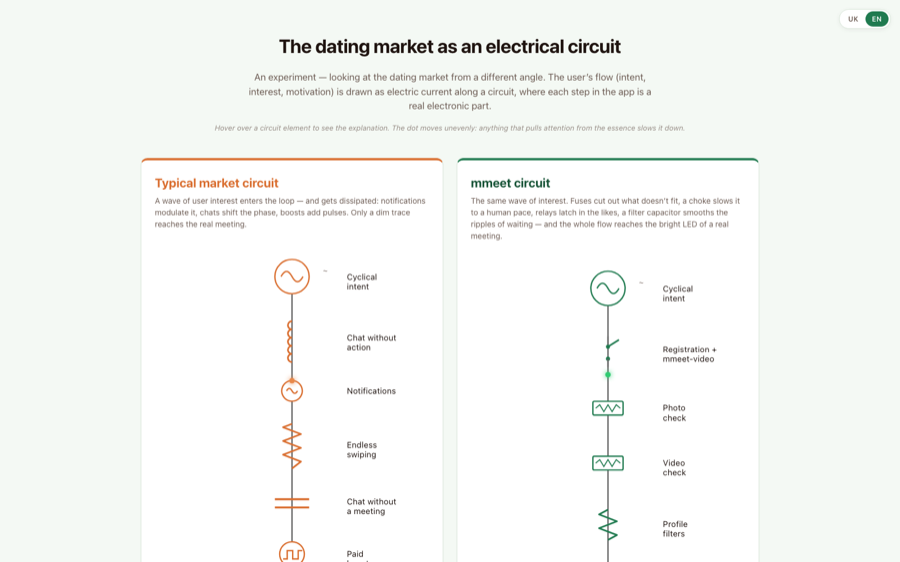
The schematic is live — open the interactive version: charge moves through both circuits in real time, and hovering a component shows which dating mechanism it stands for.
Electrical schematics have been formalized for over a century. Their language is one of physical reality, strictly describing how energy moves through a system, where it converts into useful work, and where it dissipates as heat. When an engineer looks at a circuit diagram, they immediately see the bottlenecks, resistances, and the overall efficiency of the loop. The online dating market lacks such rigorous formalization and is usually described through psychology or marketing metrics. However, when dating mechanisms are observed through the lens of classical electronics, the structural aspects of the market become transparent. In the diagram above, we model this space as two parallel electrical circuits. The power source is human intent to find a connection — it enters the system as alternating current with a distinct cyclical nature. The left side reflects the typical industry model, while the right side demonstrates the direct path implemented in mmeet. The difference in the speed of the charge and the brightness of these two circuits is the primary subject of observation.
Translating digital mechanisms into the language of electronic components brings mathematical clarity. For instance, a resistor in a typical circuit represents continuous profile swiping. It creates constant resistance, causing energy to dissipate into the surrounding space as the charge moves through it. An inductor acts as a prolonged text chat: it can accumulate significant voltage and maintains activity within the system, but its nature smooths out sudden changes, stretching the transition to an actual meeting over time. A capacitor acts as a storage for inactive conversations — it holds a potential that gradually fades. A small AC source plays the role of a notification system, generating additional interruptions. A pulse generator is the analog of a paid boost. It creates brief spikes of activity, locally accelerating the movement, yet it operates on top of the existing architecture of dissipation. A diode that clips a portion of the signal technically describes the mechanics of a paywall.
The useful load — the reason the circuit is closed in the first place — is represented in both systems by a Light Emitting Diode (LED), symbolizing a real offline meeting. In the typical circuit, a noticeable physical phenomenon occurs: by the time the charge reaches this diode, it is moving almost twelve times slower than at the start. The charge transfers its kinetic energy to each intermediate component — during waiting periods, signal filtering, or passing through diodes. As a result, the LED glows dimmer, as only a fraction of the initial energy reaches it, while the rest is converted into heat across the preceding sections of the loop.
Such engineering optics reveal processes that typically remain behind the scenes of modern interfaces. They demonstrate that heating in a system naturally follows from its architecture. The industry has evolved for decades toward maximizing screen time. When a product supports its operation through ad impressions or the generation of additional impulses, its schematic is predictably formed to keep the charge inside the loop for extended periods. From a physics perspective, this is realized through branched paths and high-resistance components. The speed of the charge decreases on its way to the diode, and a substantial volume of energy is transformed into heat rather than being delivered directly to the useful load. This physical distribution of energy forms the basis for the phenomenon of digital dating fatigue.
The mmeet circuit is built upon a different configuration of energy flow. Every component here is positioned on the mainline path to a meeting, without parallel branches. The system starts with fuses — photo and video validation — that protect the downstream circuit from anomalies and incorrect impulses. Instead of inductors, there is a transformer — video presentations, which convert voltage while maintaining frequency. This is followed by a crystal oscillator for the synchronous exchange of greeting videos, and a controlled relay for precisely scheduling the time. A smoothing capacitor ensures a stable state until the agreed time. The direct route allows the charge dot to move at a uniform speed. The LED at the end of this circuit receives enough energy to light up brightly and consistently. This configuration is the technical realization of mmeet's core philosophy: "don't take what's not yours, give only what's needed".
This visual experiment is the first step within a broader concept of a market analyzer. Just as engineers use reference manuals to catalogue electronic board components, digital interaction mechanisms can also be strictly classified by their impact on the flow of energy. Such an approach allows for the design of systems focused on direct throughput, expanding the understanding of how different architectural choices affect the final outcome for the user.